
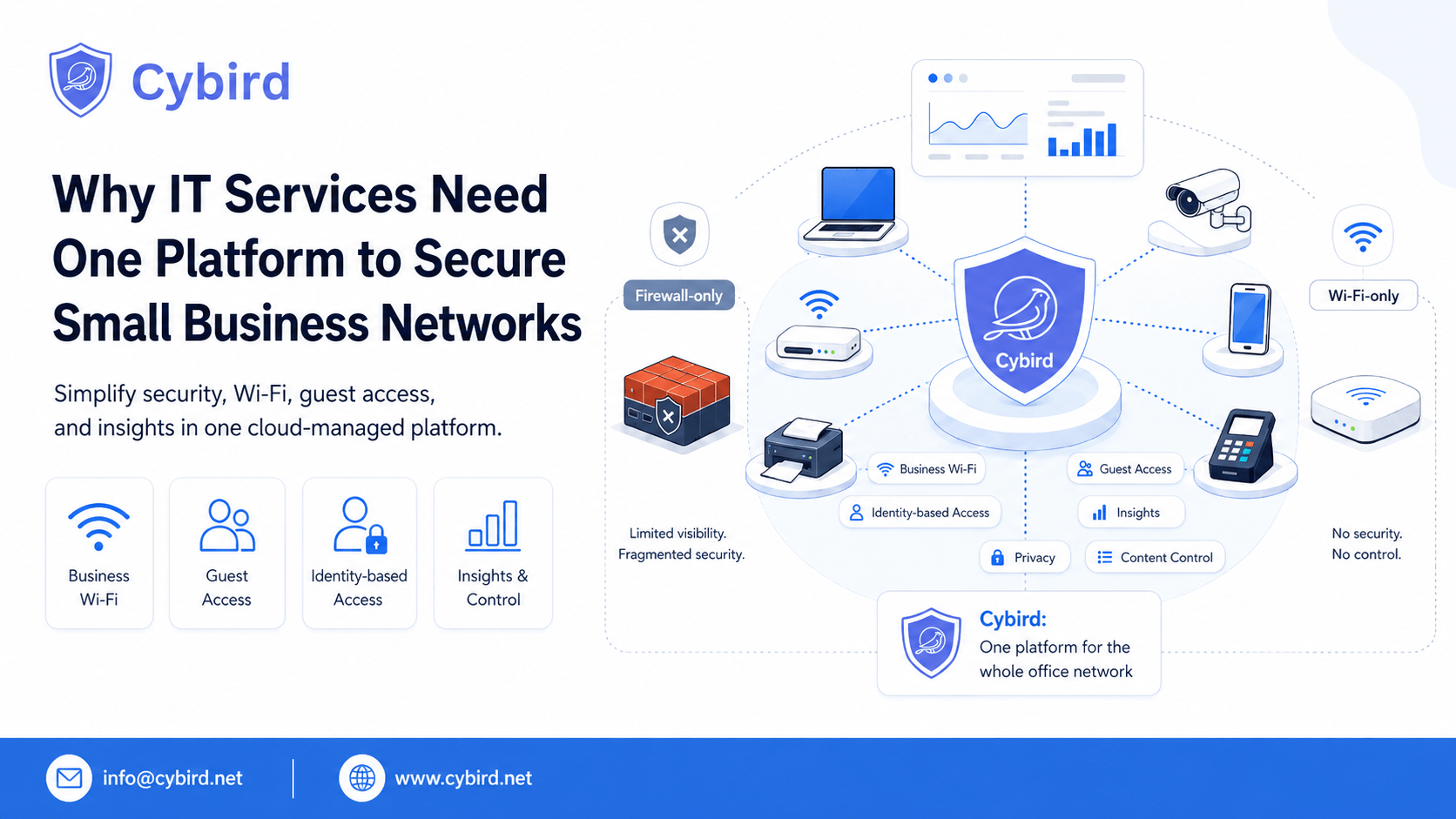
Small businesses run on one network.
That network now carries employees, guests, laptops, phones, printers, CCTV, POS systems, and other IoT devices. It supports business apps, customer traffic, video calls, cloud access, and daily operations. And increasingly, IT-Services providers are the ones expected to secure, manage, troubleshoot, and support that entire environment without adding more complexity.
That is where the current market often falls short.
Most vendors give small businesses either a security box or a Wi-Fi system. But for a 5-to-25 user office, that is rarely enough. The real need is broader: secure access, reliable business Wi-Fi, guest management, device visibility, content control, reporting, privacy, and simple ongoing management.
Small businesses do not need more point products.
They need one platform that helps secure and run the entire office network.
The small business network has changed
A small office network is no longer just about internet access.
It is now the operational layer of the business. Employees connect from laptops and phones. Guests expect professional Wi-Fi access. Printers, cameras, TVs, POS terminals, and other unmanaged devices sit on the same network. Meetings depend on stable video and voice traffic. Security risks increasingly show up through phishing, unsafe domains, infected devices, and weak access controls.
But most small businesses are still stuck between two imperfect choices.
Consumer-grade products are too light for business use. Enterprise products are often too complex, too fragmented, or too operationally heavy for a small office environment.
That leaves a clear gap in the market.
Why “firewall-only” is not enough
Traditional security vendors are often approached as firewall vendors first.
That still matters. Firewall protection is important. But for a small business office, the job is bigger than perimeter security alone.
A firewall does not automatically solve business Wi-Fi, guest access, identity-based employee access, content control, office-wide privacy features, IoT visibility, or day-to-day reporting for the business owner or IT provider.
For small business customers, the network experience is not split into separate categories. It is one environment that has to stay secure, reliable, and manageable every day.
That is why a firewall-only approach often becomes incomplete.
Why “Wi-Fi-only” is not enough either
Wi-Fi vendors solve a different part of the problem.
They help businesses get devices connected. They help improve coverage and performance. But for small businesses, connectivity alone is not the finish line.
They also need protection from phishing, malware, and botnet traffic. They need professional guest access. They need control over websites, categories, and apps. They need visibility into what is connected. They need to understand which devices belong to employees, guests, or IoT. And they need a way to manage all of this without stitching together more tools.
That is why a Wi-Fi-only approach is also incomplete.
The real problem is fragmentation
The biggest issue for small businesses is not that firewall tools are bad or that Wi-Fi tools are weak.
The real issue is that too many small offices are asked to build a complete network experience from disconnected products.
One product for firewall. Another for Wi-Fi. Another for guest access. Another for content filtering. Another for reporting. Another for privacy. Then an IT provider has to explain it, deploy it, maintain it, and troubleshoot it.
That creates friction for everyone.
For the customer, it creates complexity and blind spots.
For IT-Services teams, it creates tool sprawl, policy inconsistency, slower support, and more operational overhead than the customer account can justify.
Cybird is built as the operational layer for the whole office network
Cybird is not just a router, not just a firewall, and not just a Wi-Fi product.
Cybird is a small business network security and business Wi-Fi platform built to secure, manage, and improve the office network through one simple, cloud-managed system.
The idea is straightforward: instead of asking small businesses and IT providers to assemble multiple point products, Cybird brings the core network functions together in one platform designed specifically for small business environments.
That includes:
- business Wi-Fi
- phishing, malware, botnet, and firewall protection
- DNS privacy, ad blocking, and tracker blocking
- secure guest Wi-Fi with captive portal
- per-employee Wi-Fi login with identity-based access
- website, category, and app controls
- deeper visibility, analytics, and reports
- QoS for meetings and critical work traffic
- IoT protection and connected device awareness
- device security posture visibility
- simple cloud management with future improvements rolled out through the platform
Protection that fits the modern office
Small businesses need security that works in the background without becoming a project.
Cybird helps protect the office network with phishing protection, malware protection, botnet protection, and firewall protection. That gives small businesses a stronger default layer of network protection without forcing them into enterprise-style complexity.
Just as important, Cybird extends beyond classic security categories. Privacy features like DNS privacy, ad blocking, and tracker blocking help create a cleaner, safer, more controlled internet environment across the office.
This matters because modern risk does not only come through dramatic attacks. It often arrives through unsafe browsing, malicious domains, infected devices, and unmanaged access.
Access should be controlled, not shared blindly
In many small offices, one shared Wi-Fi password ends up doing too much work.
That creates confusion between employees and guests, weakens accountability, and makes it harder to apply the right policies to the right users.
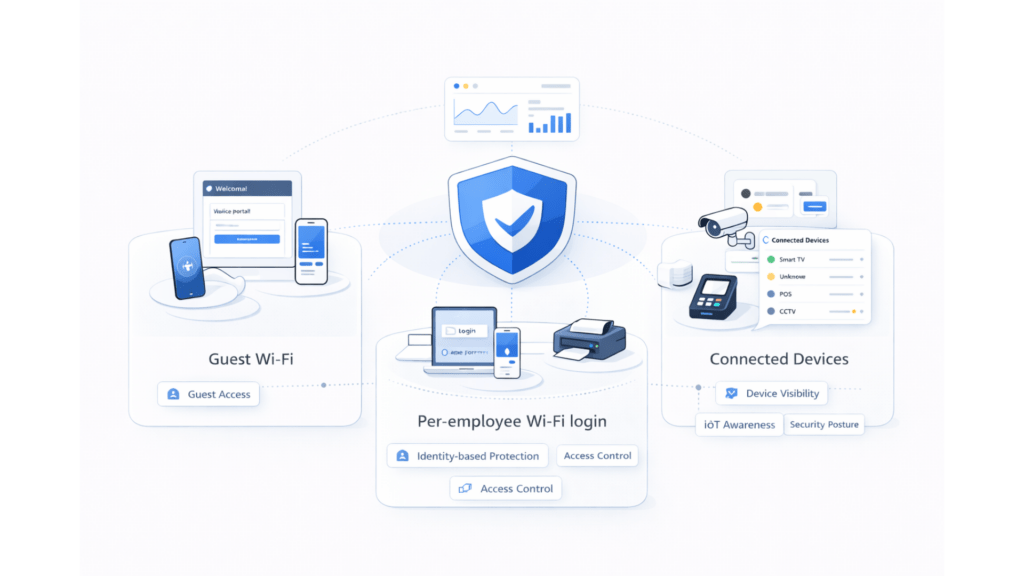
Cybird takes a more practical approach. It supports secure guest Wi-Fi with captive portal for a professional visitor experience, while also enabling per-employee Wi-Fi login for identity-based protection and access control.
That gives the office a cleaner structure: guests are separated, employees are identified, and the network becomes easier to control.
Visibility matters, especially for unmanaged devices
One of the most common small business problems is simple: nobody is fully sure what is on the network.
Printers, CCTV systems, POS terminals, TVs, and other IoT devices often remain connected for years with very little visibility. But these devices still create operational and security risk.
Cybird helps solve that with clearer connected-device visibility, device awareness, and device security posture insights. That helps businesses and IT providers better understand what is connected, what may need attention, and where policy or protection should be improved.
Better visibility leads to better decisions. It also builds trust with customers because the network is no longer a black box.
Performance and control are part of the job too
A good small business network should not only be secure. It should also support productivity.
Cybird makes it easier to block websites, categories, and apps where needed, while also helping prioritize important traffic such as Zoom, Teams, calls, and other work-critical applications.
That combination matters for small offices. The network has to protect the business and help people work smoothly at the same time.
Why this matters for IT-Services
This is where the Cybird model becomes especially compelling for IT-Services providers and SMB-focused channel partners.
Instead of managing separate layers across each customer site, they can standardize on one platform built for the realities of small office environments.
That means:
- fewer tools to deploy and support
- more consistent policy across customer sites
- faster troubleshooting
- clearer visibility into network activity and connected devices
- a more professional guest and employee access model
- better reporting for customer conversations
- a simpler way to deliver network security and business Wi-Fi as an ongoing managed service
This is not only a technology advantage. It is an operational advantage.
For IT-Services teams, that can mean lower support burden, more repeatable deployments, better service differentiation, and a stronger recurring service model around small business network protection.
Simplicity is not a minor feature. It is the value
Small businesses do not benefit from enterprise-style complexity. Neither do the IT partners supporting them.
The best product for this market is not the one with the most layers, consoles, or manual work. It is the one that delivers the right mix of protection, control, visibility, and performance in a way that is easy to deploy and easy to manage.
That is exactly why Cybird exists.
It helps secure the business through the network, while reducing the operational drag that comes from piecing together multiple tools.
A better standard for small business networks
The small business market does not need another fragmented stack of firewall, Wi-Fi, guest access, filtering, reporting, and visibility tools.
It needs a better standard.
A standard built around the reality that small businesses run on one network, and that network now carries the entire office. A standard built for customers who want strong protection and smooth operations without enterprise overhead. And a standard built for IT-Services providers who need a simpler, more repeatable way to support small business customers well.
Cybird is that approach.
Closing: Small businesses do not need just a firewall appliance or just Wi-Fi hardware. They need one simple platform that secures, manages, and improves the entire office network.
CTA: If you support small business customers, Cybird gives you a simpler way to deliver secure business Wi-Fi, network protection, visibility, and control through one cloud-managed platform. Talk to us about a partner PoC.

Founder & CEO of Cybird.